Has Two Lenses and Can Give Magnify an Item Up to 1,500 Times.
Nobel Laureate Dr. Alan Finkel recently said , "Without microscopy, in that location is no modernistic science." However, have you always wondered how these instruments were created? Microscopes accept come up a long manner since the start version was introduced centuries agone, every bit have the crucial discoveries scientists are now able to uncover. In item, cryo-electron microscopy (cryo-EM) instruments are at present to scientists what scalpels are to surgeons – tools of activeness, not merely observation.
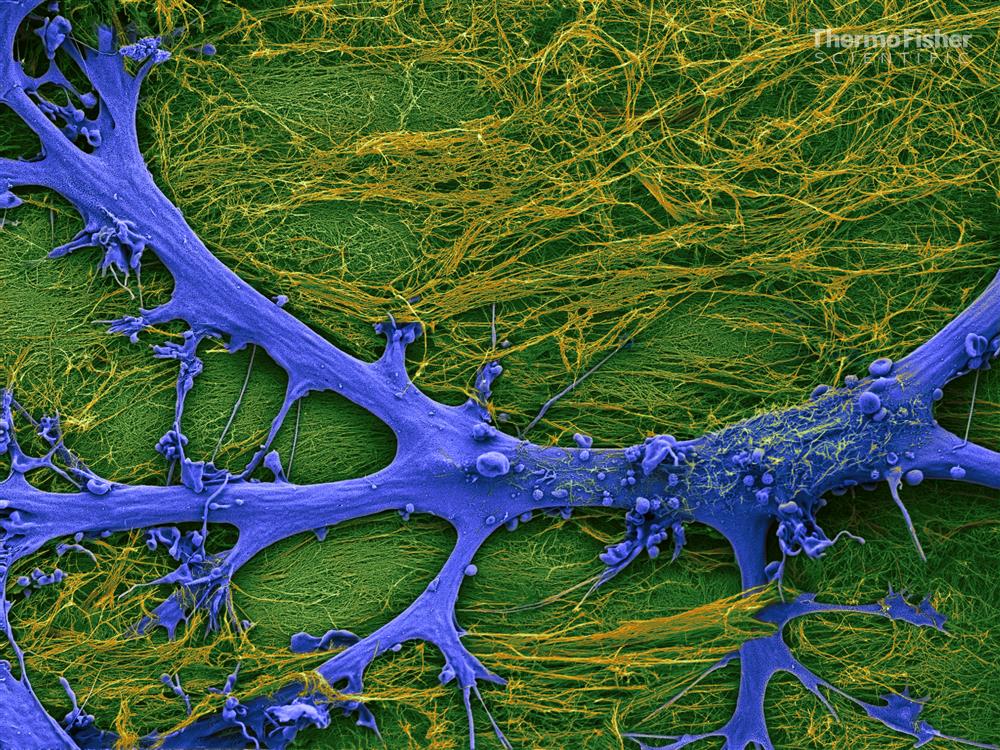
Cryo-EM image depicts the interaction between a brain cell (blueish) and a constructed material (green), mimicking the extracellular environment.
Humans are inherently curious, and our fascination for the unknown drives united states to dig into some of life's most difficult challenges. Today'southward advanced microscopes help scientists run across the structure of viruses and proteins in 3D! Scientists now use these advanced microscopes and new technologies to written report neurodegenerative diseases, such as Alzheimer's, Parkinson's, Huntington's; also as cancers including HIV, malaria, the Zika virus and many others. A better understanding of how proteins and viruses function can aid researchers speed the path to more than effective treatments and therapies.
The Starting time of Microscopy
The evolution of the microscope started almost as soon every bit the instrument was developed in the 1500s. As scientists in the 16th century began making strides in biological science and chemistry, they knew they would demand to see more than the naked middle would let. Their solution was to utilise glass to bend light, thus creating the magnifying glass. But what would happen if they put multiple lenses together? In the late 1500s, two Dutch spectacle makers, Zacharias Janssen and his father Hans, took information technology upon themselves to find out. They stacked a number of lenses in a tube and realized that, together, they made items appear much larger than nether a unmarried magnifying glass. Because the maximum magnification was only 9x, they were more of a novelty than a scientific instrument.

Sketch of early on microscopical nature discovery by Antonie Van Leeuwenhoek in 1825.
Antony Van Leeuwenhoek, a Dutch scientist and one of the pioneers of microscopy, became the first to create and use a microscope for scientific purposes. His hand-held, single-lens microscopes were made by grinding and and so polishing glass balls into curved lenses, finding that the curvature allowed him to encounter objects up to 270x larger than with the naked centre. By comparison, microscopes using flat lenses could but run into up to 50x magnification. He used his new microscope to analyze insects and eventually discover bacteria, earning him the title, "Begetter of the Microscope."
To build on the ability of a unmarried-lens microscope, scientists had to find a style to reduce the focal length of the microscope while maintaining the lens diameter. If the lens was reduced too much, information technology would exist difficult to come across through and the images could go blurry. The solution: compound microscopes.
A compound microscope uses two or more than lenses to enlarge an paradigm to a college magnification. Its basic structure consists of ii parts:
ane. the objective, the lens closest to the object being viewed, and
2. the eyepiece, the lens closest to the eye.
Combined, these new chemical compound microscopes let researchers run into single-cell organisms, yeast and other building blocks of life in unprecedented particular, despite the images being slightly distorted because the glass was low-quality and the lenses imperfectly shaped. At their core, even today'due south massive microscopes are considered compound microscopes.
From Photons to Electrons
In 1900, visible light microscopes reached their theoretic limit of resolution. Physics dictates light microscopes are express to magnification of 500x to 1000x and a resolution of 0.two micrometers (ii,000 angstroms). Four years later, Carl Zeiss overcame this limitation and introduced the starting time commercial UV microscope, which had resolution twice as powerful equally a visible light microscope. Nevertheless, information technology wasn't until nearly 30 years later that researchers found a way to blast through these limitations altogether.
In 1931, two German scientists, Ernst Ruska and Max Knoll, institute a way to achieve a resolution greater than that of light. They stopped using light, instead realizing they could transmit electrons through a specimen to form an image. This discovery led to the kickoff transmission electron microscope (TEM), where the electrons are pointed straight at the sample and pass through information technology to create the image.
X years subsequently, Ruska created a like however unlike approach using a focused axle of electrons to scan a sample'southward surface in a rectangular pattern to deliver information nearly its topography and composition. Unlike TEM, the paradigm from this new scanning electron microscope (SEM) was created after the microscope nerveless and counted the scattered electrons.
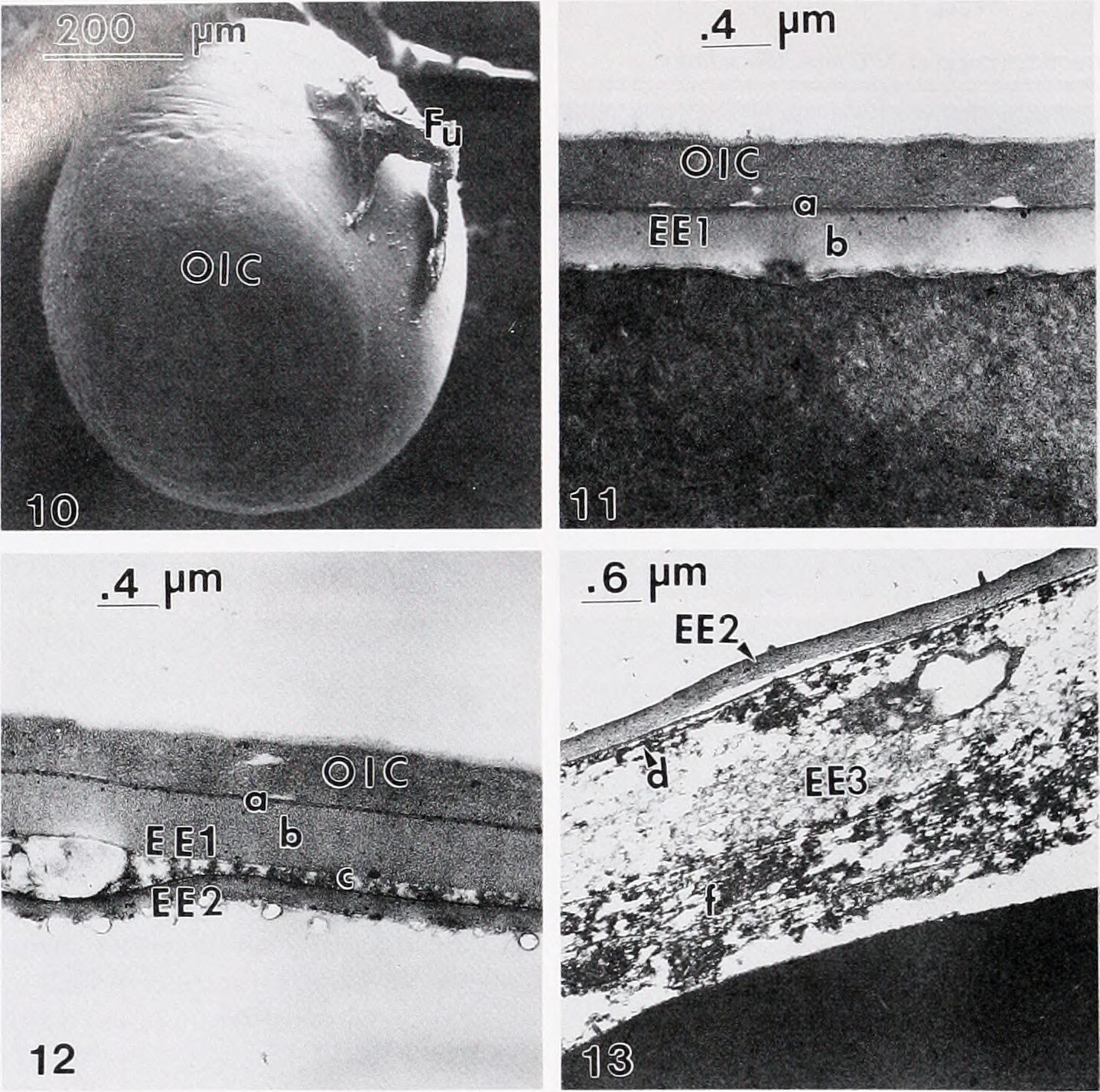
Transmission electron micrograph images of Palaemonetespugio (grass shrimp) embryos showing the development of an embryonic coat, from 1933.
Going Digital
In 1986, scientists in Nippon introduced the digital microscope, which many claim revolutionized microscopy. They created a way to transfer the image from under the microscope to a estimator for instant analysis. Nowadays, microscopes have congenital-in, high definition monitors, eliminating the need for an external computer to view images.
Moving from 2nd to 3D with Cryo-EM
The major challenge with microscopy, even upwardly to recent years, was recreating the fuzzy 2nd images equally sharp 3D structures. Over the course of nearly two decades, iii researchers – Jacques Dubochet, Joachim Franck and Richard Henderson – created a technique for generating a 3D structure of the protein at an atomic level using an electron microscope. Their technique used vitrification to cool a sample to cryogenic temperatures, thereby allowing the biomolecules to retain their shape in a vacuum. This arroyo, chosen cryo-electron microscopy (cryo-EM), was awarded the Nobel Prize in Chemistry in 2017.
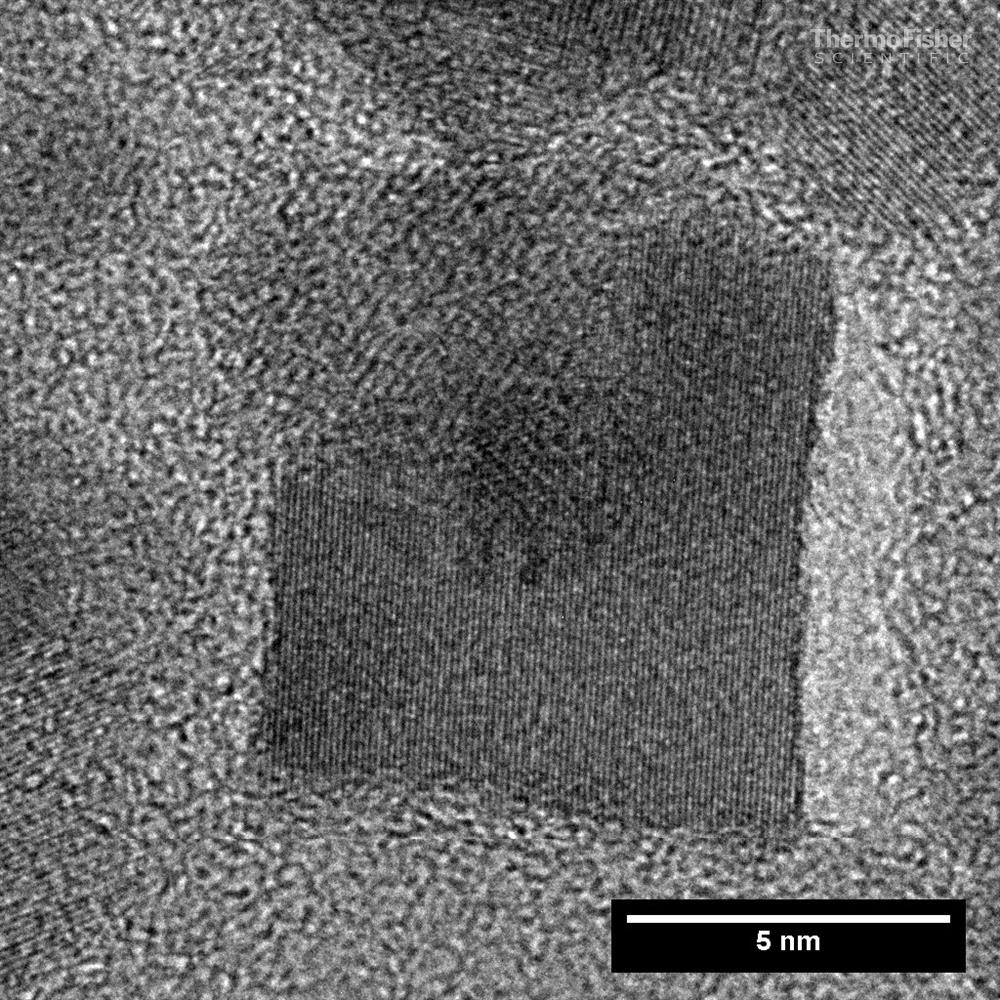
Image of the birth of a carbon nanotube from a cobalt ferrite nanoparticle obtained using a Thermo Scientific Krios 3Gi Cryo-TEM.
Looking dorsum, the microscope has come a long way. From single-lens magnifying spectacles to today'southward massive electron microscopes, this applied science is changing science. Thanks to the advancement of microscopes, we're able to see items at the atomic level and up to 10,000,000x more than the human heart tin see.
To larn more about microscopy, fill out this form to speak with an expert.
Source: https://www.thermofisher.com/blog/microscopy/the-history-of-the-electron-microscope/
0 Response to "Has Two Lenses and Can Give Magnify an Item Up to 1,500 Times."
Post a Comment