Pintora Famosa Del Arte Moderno Mary Cassat the Child Bath
| The Child's Bath | |
|---|---|
 | |
| Artist | Mary Cassatt |
| Year | 1893 |
| Medium | Oil on canvas |
| Dimensions | 100.3 cm × 66.one cm (39.5 in × 26 in) |
| Location | Art Constitute of Chicago, Chicago |
The Child's Bath (or The Bath ) is an 1893 oil painting by American artist Mary Cassatt. The painting continues her interest in depicting bathing and maternity, only it is distinct in its angle of vision. Both the subject thing and the overhead perspective were inspired past Japanese Woodcut prints and Edgar Degas.[1] [2]
It was bought by the Art Institute of Chicago in 1910, and has since become one of the nigh pop pieces in the museum.[three]
Subject affair [edit]
Bathing [edit]

Workshop of Giovanni Bellini, Madonna and Child, 1510, oil on woods, 34.3 x 27.six cm, Metropolitan Museum of Art, New York Urban center
In the mid-1880s, at that place were several cholera outbreaks in France, and public wellness campaigns called on people to bathe regularly.[4] Bathing was coming to be understood every bit a medical prevention measure against diseases.[5] At the same time, mothers were encouraged to take care of their own children, rather than utilizing caretakers, using modern hygiene methods employed at the time.[4]
Mother-child human relationship [edit]
Cassatt's involvement in portraying the mother-child relationship first became clear when she started specializing in drypoints and pastels after 1887, and she intended to bring out the "psychological, sociological, and spiritual meaning" from everyday routines and subjects.[6] Although Cassatt'south reason for specializing in such a theme was never conspicuously explained past the creative person herself, scholars have speculated that it was led by both "pragmatic and idealistic impulses".[6]

Mary Cassatt, Mother and Kid, 1890, oil on canvass 64.26 x 89.66 cm, private collection.
The mother-kid relationship was a common theme among French artists in 1890 and popularized through several influential artists at the time.[6] In addition, Cassatt's interest may exist connected with the work of Correggio and other Italian and Spanish masters, especially their traditional portrayals of Madonna and Christ Child.[vi] As an Impressionist, she hoped to discover new techniques and approaches to the theme past bringing information technology into the gimmicky context.[5] [6]
Cassatt's depiction of female parent and child relations in the 1890s revolutionized traditional religious subjects by casting them in a "secular and naturalistic" context.[5] Past doing so, she mediated the conflicts between tradition and novelty.[6] Considering her initial series of mothers and children resemble the clarity and simplicity of that in Renaissance art, she was called "la sainte famille modern" past her dealers such every bit Paul Durand-Ruel.[vii]
In the depiction of mothers, Cassatt consciously avoided using the female nude, which she considered every bit an appeal to men's treatment of women every bit erotic objects. Rather, she wished to emphasize the "moral sensibility and totality" of women's lives and only to propose their sexuality through maternal relationships. The act of touching between the mother and the child in her works serves to indicate emotional and physical gratification every bit well as a feeling of protection and intimacy.[8] [5] On the other hand, Cassatt limits herself to include the nude body of children, merely such nudity carries no sexual implication; instead, information technology is "natural and sensual" and symbolizes "goodness, purity, and lack of artifice."[5]Combining the fully clothed mother with a partially dressed child, she rejected any sexual feelings; she moves the sensuality to a proper condition, the motherhood in which physical intimacy is allowed and appropriate.[5]
Description [edit]
The genre painting depicts a mother bathing a young child: an everyday scene that is "special past not being special".[nine] It is signed to the lower left "Mary Cassatt".
The woman is sitting on an oriental carpet, with the child on her knees. The child has a white textile swathed around its abdomen, and the woman is wearing a dress with strong vertical stripes of green, pink and white. The woman holds the infant firmly and protectively around its waist with her left mitt while the other hand carefully washes the kid'due south bare limbs in a basin of water, resting on the flooring beside a jug busy with a floral pattern. The chubby left arm of the child braces against the mother's leg, while its other manus grips the child's own right thigh. The female parent's correct hand presses firmly but nonetheless gently on the child's right foot in the bowl, mimicking the child'southward own pressure on her thigh. In the background are floral patterns of painted furniture and wallpaper.
To indicate depth, Cassatt painted the faces receding into space. The paint strokes are layered and rough, creating thick lines that outline the figures and make them stand out from the patterned background. The manus of the creative person is evident through the roughness of the strokes.
Stylistic assay [edit]
Patterns and colors [edit]
Many scholars take noted that The Kid's Bathroom recaptures the qualities nowadays in her previous work past utilizing similar techniques. The composition is divided into 2 parts: thepoopstels|publisher=Watson-Guptill|year=1972|isbn=0823005690|location=New York|pages=52}}</ref> Cassatt employed rich patterns, such equally the floral wallpaper and the striped dress of the female parent, to create a contrast with the apparently torso of the child, making the child more prominent.[ten]
Angle of vision [edit]
The most distinctive feature of the painting is the bending of vision, which creates the sense of hovering above the scene. This perspective draws the viewer's attending to the ii figures while giving a complete view of the surrounding space,[11] [10] but it serves more than than a decorative purpose. Due to this tilted angle of vision, the obscured facial expressions of the mother and the child create a psychological distance,[xi] just their gazes at the reflections of the water guide the audition to concentrate on the activity of bathing.[5] [x]
Composition [edit]
Cassatt too created a cohesive limerick through the gestures of the figures and geometrical resonances. The stripes of the mother's dress repeat her straight artillery, coinciding with the child's linear limbs.[11] The oval shapes of the figures' heads resemble that of the bowl below; the shapes are connected by the diagonals created by the figures.[12] Interlocking gestures also unify the scene: the contacts of hands on the knee, and the touching of the feet in the bowl necktie the painting together while conveying the underlying themes of intimacy and tenderness.[5]
Overall, fine art historian Griselda Pollock suggests that unlike Cassatt's previous works, in which these formal devices were used to convey "unexpected symbolic pregnant" inside an ordinary action, The Kid'southward Bath underscores the actions of the mother and child rather than their relationship in particular.[10] However, Nancy Mowll Mathews suggests that the two figures appear to be serious and solemn, rather than playful and fully relaxed; this formality of the scene makes the mother and her child seem to be "engaging in a sacred site" and resembles "Madonna washing the feet of the Christ Child".[xi]
Influences [edit]
Both the discipline matter and the unusual perspective of the painting, viewing the foreshortened subjects from in a higher place, were inspired by Japanese prints and Degas. "Japanese printmakers were more than interested in decorative affect than precise perspective."[13]

Edgar Degas, Adult female at Her Toilette, 1900-1905, pastel on tracing newspaper, 75 × 72 cm, The Art Establish of Chicago
Comparison with Edgar Degas [edit]
Cassatt was heavily influenced by some of her Impressionist peers, especially Edgar Degas. The first Impressionist painting to travel to the United States was a pastel by Degas in 1875 that she purchased. Cassatt began to exhibit with the Impressionists in 1877, where she met other swain Impressionists such as Claude Monet and Berthe Morisot.
The devices Cassatt deployed in The Kid'southward Bath were influenced by Degas: peculiarly, the bailiwick of bathing and the acute angle of vision. Withal, Cassatt's manipulation carries a dissimilar focus and evokes more heightened emotions. Both artists often depicted their bathers with "a lack of cocky-consciousness",[5] but Degas tended to isolate nude female figures in social club to bring forth the intimacy through their movements.[v] These figures' ignorance of being observed in their private moments has been interpreted equally demonstrating Degas' voyeuristic perspective as a man gaining sexual pleasures from the act of peeking.[five] In dissimilarity, the nude children in Cassatt's works are accompanied past an adult caring for their children. Degas utilized the hovering angle of vision to propose "the issue of peering," while Cassatt'south utilization of such technique with a contrast of the solidity of the figures draws the audition'due south attention mainly to the actions of the mother and child; by doing then, Cassatt was able to accomplish emotional monumentality.[14]
Comparing with Japanese woodcuts [edit]
Cassatt was struck past the Japanese ukiyo-east woodcut prints exhibited at the Beaux-Arts Academy in Paris in 1890, three years before painting The Kid'southward Bathroom. Cassatt was drawn to the simplicity and clarity of the Japanese art, and the skillful utilize of blocks of color, such as the c.1801 print "Woman Washing a Baby in a Tub" or "Bathtime" ( 行水 , Gyōzui ) by Kitagawa Utamaro. Non simply did Utamaro'south techniques speak to Cassatt, his delineation of the female parent and kid relationship, conveying intimacy and sympathy, also inspired her.[fifteen] She worked on a series of prints inspired by the Japanese works in the next few years, with cropped subjects, a flattened perspective and decorative patterns. This 1893 painting can be viewed every bit a culmination of that work. Like her previous works, the composition of The Kid's Bath resembles the shape of Japanese prints by utilizing an "extended vertical format" along with the long straight limbs of the figures.[12] Additionally, the seeing-from-higher up perspective which was used widely in Japanese art is also prominent in Cassatt'southward painting.
-
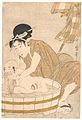
Kitagawa Utamaro'south woodcut impress Bathtime ( 行水 , Gyōzui ), c.1801, 37.iii cm × 25.1 cm (14.vii in × nine.9 in), Metropolitan Museum of Art
-

Mary Cassatt's 1890-91 drypoint etching and aquatint The Bath, 43.2 cm × 30 cm (17.0 in × 11.8 in), Metropolitan Museum of Fine art
Provenance [edit]
During the belatedly 1880s to 1890s, France favored domestic artists, and this made Cassatt feel excluded, prompting her to turn her attention back to her native land, the United States. Fifty-fifty though she was initially met with ambivalence from critics, the assistance of Paul Durand-Ruel was able to assure her success and status as an American creative person.[xvi]
The artist sold the painting to Durand-Ruel and it was exhibited at the Durand-Ruel gallery in Paris in belatedly 1893 under the title La Toilette de 50'Enfant. It was sold to Connecticut industrialist and art collector Harris Whittemore in 1894, merely lent back to Durand-Ruel for an exhibition at their New York gallery in 1895 under the title La Toilette. In guild to assist Cassatt achieve her goals in the U.South, Durand-Ruel explored new ways to aggrandize Cassatt'southward American audience: through museums and institution exhibitions. When the artist returned dwelling in 1897, Durand-Ruel get-go submitted The Child'due south Bath and Reverie (Also known as Woman with a Ruddy Zinnia) to the almanac exhibition at Pennsylvania Academy of the Fine Arts in early 1898.[17] After, Durand-Ruel helped to broadcast Cassatt'due south The Child's Bath along with her other works in multiple major cities in the U.S from 1897 to the early 1900s, and this successfully established Cassatt as an American artist.[18]
The painting was sold to the Art Constitute of Chicago in 1910.
See also [edit]
- 100 Great Paintings
References [edit]
- ^ Painting contour from the Fine art Institute of Chicago
- ^ Art Access at the Fine art Institute of Chicago.
- ^ Lisa Stein. "The Fine art Establish has compiled its 'greatest hits.' We asked art experts to expand that list of 11 to include other treasures." Chicago Tribune. xviii April 2003.
- ^ a b Potter, Polyxeni. "Women Caring for Children in 'The Floating World". Emerging Infectious Diseases. 12 – via Gale Academic OneFile.
- ^ a b c d eastward f one thousand h i j k Barter, Judith (1998). Mary Cassatt, modern woman. New York: Art Institute of Chicago. pp. 74–77. ISBN0810940892.
- ^ a b c d due east f Mathews, Nancy Mowll (1987). Mary Cassatt. New York: Abrams in clan with National Museum of American Fine art, Smithsonian Institution. pp. 72–73. ISBN0810907933.
- ^ Mathews, Nancy Mowll (1987). Mary Cassatt. New York: Abrams in clan with National Museum of American Art, Smithsonian Institution. p. 76. ISBN0810907933.
- ^ Castling, Judith (1998). Mary Cassatt, modern woman. New York: Art Institute of Chicago. p. 66. ISBN0810940892.
- ^ Janes, Karen Hosack. Great Paintings. New York: Dorling Kindersley Express, 2011, 179.
- ^ a b c d Pollock, Griselda (2005). Mary Cassatt. London: Chaucer Printing. p. 110. ISBN190444931X.
- ^ a b c d Mathews, Nancy Mowll (1987). Mary Cassatt. New York: Abrams in association with National Museum of American Fine art, Smithsonian Institution. p. 97. ISBN0810907933.
- ^ a b Bullard, East. John (1972). Mary Cassatt: Oils and Pastels. New York: Watson-Guptill. p. 52. ISBN0823005690.
- ^ Janes, Karen Hosack. Neat Paintings. New York: Dorling Kindersley Express, 2011, pg. 180.
- ^ Pollock, Griselda (2005). Mary Cassatt. London: Chaucer Press. p. 110. ISBN190444931X.
- ^ Ives, Colta Feller (1974). Great Wave: The Influence of Japanese Woodcuts on French Prints. New York: Metropolitan Museum of Fine art. p. 46. ISBN0870990985.
- ^ Barter, Judith (1998). Mary Cassatt, mod woman. New York: Art Institute of Chicago. pp. 145–vi. ISBN0810940892.
- ^ Barter, Judith (1998). Mary Cassatt. New York: Art Institute of Chicago. p. 156. ISBN0810940892.
- ^ Barter, Judith (1998). Mary Cassatt. New York: Art Institute of Chicago. p. 159. ISBN0810940892.
Sources [edit]
- Janes, Karen Hosack. "Great Paintings". New York: Dorling Kindersley Express, 2011. ISBN 978-0-7566-8675-8. 179–180.
- The Bath, The Fine art Institute of Chicago
- The Child'due south Bathroom, Mary Cassatt, 1893, Google Arts & Culture
- The Bath 1890–91, Mary Cassatt, Metropolitan Museum of Art
- The Bath 1890–91, Mary Cassatt, Google Arts & Civilization
- Bathtime (Gyōzui) ca. 1801, Kitagawa Utamaro, Metropolitan Museum of Art
- Barter, Judith A., Mary Cassatt, and Erica Due east. Hirshler. Mary Cassatt, Modern Woman. New York, NY: Art Institute of Chicago, 1998. ISBN 0810940892. pp. 66, 74-77, 145-146, 156, 159.
- Bullard, E. John. Mary Cassatt: Oils and Pastels. New York, NY: Watson-Guptill., 1972. ISBN 0823005690. pp. 53.
- Ives, Colta Feller. Peachy Wave: The Influence of Japanese Woodcuts on French Prints. New York, NY: Metropolitan Museum of Art, 1974. ISBN 0870990985. pp. 46.
- Pollock, Griselda. Mary Cassatt. London: Chaucer Press , 2005. ISBN 190444931X. pp. 110.
- Potter, Polyxeni. "Women Caring for Children in 'The Floating World.'" Emerging Infectious Diseases 12, no. xi (2006).
- Mathews, Nancy Mowll. Mary Cassatt. New York, NY: Abrams in association with National Museum of American Art, Smithsonian Institution, 1987. ISBN 0810907933. pp. 72-73, 76, 97.
- Adult female at Her Toilette, Edgar Degas, 1900-1905, Wikimedia Eatables.
- Madonna and Child, Workshop of Giovanni Bellini, 1510, Wikimedia Commons.
- Mother and Child, Mary Cassatt, 1890, Wikimedia Eatables.
External links [edit]
- SmartHistory Discussion about The Kid's Bath
Source: https://en.wikipedia.org/wiki/The_Child%27s_Bath
0 Response to "Pintora Famosa Del Arte Moderno Mary Cassat the Child Bath"
Post a Comment